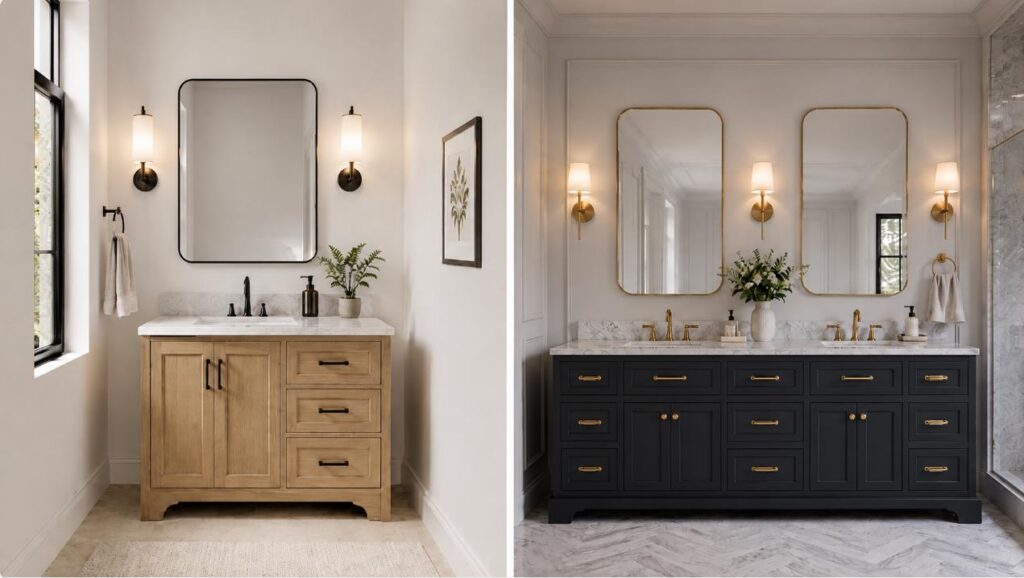
Choosing between a single vs double vanity is not just about one sink or two. It affects your budget, layout, storage, installation, and resale value. The right choice should make your bathroom easier to use, not just better to look at.
In this guide, we’ll compare cost, size, storage, maintenance, and resale value so you can decide which vanity layout fits your bathroom best.
Single vs Double Vanity Cost: What Changes the Price?
Price is often the first thing homeowners compare. In most cases, a single sink vanity costs less because it uses a smaller cabinet, less countertop material, one sink, one faucet, and one drain setup.
As a rough planning range, a basic single sink vanity with a countertop may start around $100 to $700 for smaller sizes. Larger or higher-end single vanities can cost $500 to $2,000 or more. A double sink vanity usually costs more, with many prefabricated options ranging from about $550 to $2,200, depending on size, material, countertop, sink style, and finish.
Installation is another cost to consider. A simple replacement is usually more affordable. Converting one sink to two may add labor because it can require extra water lines, drain work, mirror changes, and lighting adjustments.
| Cost Factor | Single Sink Vanity | Double Sink Vanity |
|---|---|---|
| Vanity cabinet | Smaller, usually lower cost | Wider, usually higher cost |
| Countertop | Less material | More material |
| Sink | One sink | Two sinks |
| Faucet | One faucet | Two faucets |
| Drain setup | One drain | Two drains |
| Plumbing labor | Simpler | More complex |
| Mirror and lighting | Usually simpler | May need wider or double setup |
| Installation | Usually easier | Usually more labor-intensive |
These prices are only a starting point. Your final cost depends on vanity size, cabinet material, countertop type, faucet finish, plumbing location, local labor rates, and whether you choose a ready-made, semi-custom, or custom vanity.
Before buying, compare the vanity price and installation cost separately. A lower-priced vanity may still cost more if the plumbing needs to be moved. A better-quality vanity may be worth it if it fits your layout, storage needs, and long-term design plan.
What Size Bathroom Needs a Double Vanity?

After price, size is the next thing to check. If you are choosing a small bathroom vanity, a one-sink layout is usually safer because it keeps the room open and easier to use. If the vanity is too wide or too deep, the bathroom can feel tight fast.
Here is a simple bathroom vanity size guide:
| Vanity Width | Best Choice | Best For |
|---|---|---|
| 24 inches | Single vanity | Powder rooms and tiny baths |
| 30 inches | Single vanity | Small bathrooms |
| 36 inches | Single vanity | Small to medium baths |
| 48 inches | Usually single vanity | Guest baths or compact primary baths |
| 60 inches | Double vanity | Shared baths or primary baths |
| 72 inches | Double vanity | Spacious primary bathrooms |
A 48-inch vanity can sometimes fit two sinks, but it often feels tight. For most shared bathrooms, a practical double vanity size starts around 60 inches. A 72-inch layout gives more counter space and works better in a spacious primary bathroom.
Before buying, measure wall width, vanity depth, drawer swing, door swing, toilet clearance, shower clearance, plumbing location, mirror placement, and lighting position. A two-sink layout only works well when the room still feels easy to use.
Is Single vs Double Vanity Better for Resale?
Double vanity resale value is strongest in a spacious primary bathroom. NAHB’s Eye on Housing reported that 62% of first-time buyers rated this feature as essential or desirable, so a two-sink layout can be a real selling point when the room supports it.
But fit matters. This setup works best in large primary bathrooms, shared family bathrooms, and Jack-and-Jill bathrooms. In small bathrooms, powder rooms, or narrow layouts, a one-sink option often protects value better by keeping the space open and easy to use.
- Choose a double sink vanity when two sinks improve function. Choose a single sink vanity when space, counter area, and comfort matter more.
What Are the Key Differences in Single vs Double Vanity?
Once you understand cost, size, and resale value, the next step is daily function. The main difference is not just one sink versus two sinks. It is how each layout affects movement, storage, counter space, and morning routines.
A single vanity is the practical choice when space, budget, and simple upkeep matter most. A double vanity is better when two people regularly need sink access at the same time.
| Factor | Single Vanity | Double Vanity |
|---|---|---|
| Sink count | One sink | Two sinks |
| Best for | Small baths, guest baths, powder rooms | Primary baths, shared baths, family baths |
| Space needed | Less | More |
| Plumbing | Simpler | More complex |
| Cost | Usually lower | Usually higher |
| Cleaning | Faster | Takes more time |
| Counter space | More open surface | Split between two sinks |
| Storage | More flexible layout | More total width, but more plumbing |
Lowe’s notes that single sink vanities save space and need less plumbing. Double sink vanities can work better for couples and families, but they need more room and can cost more to install.
So, single vanity vs double vanity is not really about which one is “better.” It is about which one fits your bathroom, your routine, and your budget.
When Should You Choose a Single Vanity?
Choose a single vanity if one sink gives your bathroom a better layout. It is often the best small bathroom vanity choice for powder rooms, guest bathrooms, narrow layouts, and bathrooms used by one person at a time.

A single sink vanity is a better fit when you want to:
- Keep the bathroom open and comfortable
- Create more usable counter space
- Make drawer or cabinet storage easier to organize
- Avoid making a small bathroom feel crowded
A one-sink layout can still look high-end with the right countertop, mirror, lighting, and hardware. Choose it when one sink gives you better space, function, and visual balance.
When Should You Choose a Double Vanity?
Choose a double vanity if two people often use the bathroom at the same time. It works best for primary bathrooms, shared family bathrooms, Jack-and-Jill layouts, and couples’ bathrooms.

This two-sink layout is a better fit when you want to:
- Give two users separate sink areas
- Make busy morning routines easier
- Create a more balanced look in a larger bathroom
- Add resale appeal in a spacious primary bathroom
A double sink setup works best when the room has enough width, clearance, and plumbing support. If two sinks make the bathroom feel tight or reduce useful counter space, a wide one-sink vanity may be the smarter choice.
How Do Storage and Counter Space Compare?
More sinks do not always mean more usable space. A wider vanity can add storage, but the second sink also takes up countertop and cabinet room.
| What You Need | Better Choice | Why |
|---|---|---|
| More open counter space | Single vanity | One sink leaves more usable surface for daily items |
| Two people getting ready together | Double vanity | Each person gets a separate sink area |
| Better drawer layout | Single vanity | One plumbing zone usually allows wider drawers |
| More total cabinet width | Double vanity | A larger cabinet can provide more overall storage |
| Easier under-sink organization | Single vanity | Fewer pipes make the cabinet easier to use |
| A balanced look in a large bathroom | Double vanity | Two sinks can create symmetry and visual weight |
In a small bathroom, a single vanity usually gives you better counter space and more flexible storage. In a shared or primary bathroom, a double vanity is more useful when two people need sink access at the same time.
The key is not vanity size. It is usable space.
How Do Installation and Maintenance Compare?
A one-sink setup is usually easier to install because it has one faucet, one sink, and one drain. A two-sink layout requires more planning because both sinks need to work with the plumbing, countertop, mirror, and lighting layout.
Maintenance also changes with the number of fixtures. Two sinks mean more faucet areas, drain openings, countertop edges, and under-sink plumbing to clean and manage. Choose a one-sink option when simple upkeep matters more. Choose a two-sink option when shared convenience is the bigger priority.
How Can You Decide Between Single and Double Vanity?

Use this quick check before you buy.
Choose a single vanity if:
- Your bathroom is small or narrow.
- Only one person uses it at a time.
- You need more open counter space.
- You want flexible drawer or cabinet storage.
- You are updating a powder room or guest bathroom.
Choose a double vanity if:
- Two people use the bathroom together.
- You have about 60 inches or more of vanity width.
- You are remodeling a primary or shared bathroom.
- Your family has busy morning routines.
- You want separate sink areas.
- Resale appeal matters in a spacious primary bathroom.
Simple rule: choose the vanity that makes the bathroom easier to use, not just the one that looks bigger.
FAQs
To change a single vanity to a double vanity, first check the wall width, plumbing location, countertop space, mirror layout, and lighting. You will usually need two sinks, two faucets, and extra drain or water line work. If your current bathroom only has one sink setup, have a licensed plumber review it before buying.
A single sink vanity is usually 24 to 48 inches wide. A 24-inch vanity works well in powder rooms, while 30-inch and 36-inch sizes are common for small bathrooms. A 48-inch single vanity gives more counter space and storage.
A common double vanity size is 60 to 72 inches wide. Some compact options start around 48 inches, but they can feel tight with two sinks. For better comfort, a 60-inch or 72-inch double sink vanity is usually a better choice.
A double sink vanity usually needs two faucet connections, two drain connections, and proper venting. Some layouts use separate drains, while others connect both sinks to one main drain. This is not a DIY-friendly upgrade for every bathroom. Plumbing codes vary by location, so it is best to have a licensed plumber check the setup.
A double vanity is a bathroom vanity with two sinks. It lets two people use the sink area at the same time and is common in primary bathrooms, shared bathrooms, and family bathrooms.
Conclusion
The best choice depends on your bathroom size, daily routine, and budget. If space and simplicity matter more, go with a single vanity. If shared use matters more, a two-sink setup may be the better fit.
Still not sure which vanity works best for your bathroom? Contact PA Home for practical layout guidance.