Stand in front of a house for a moment. Your eyes almost always settle on the entrance first. That’s no accident. The front door acts as a visual anchor. It tells you where to look, how to move, and how to approach the space.
A well-designed double entry door doesn’t just function as an opening—it shapes the first impression. Compared to a single door, a pair of double front entry doors increases width and balances the facade. The center becomes clearer, and entering feels intentional. But why do some doors feel warm and welcoming, while others feel quiet or even almost invisible? The secret lies in material, proportion, light, and detail. Here are ten ideas to explore.
1. Classic Wooden Double Doors
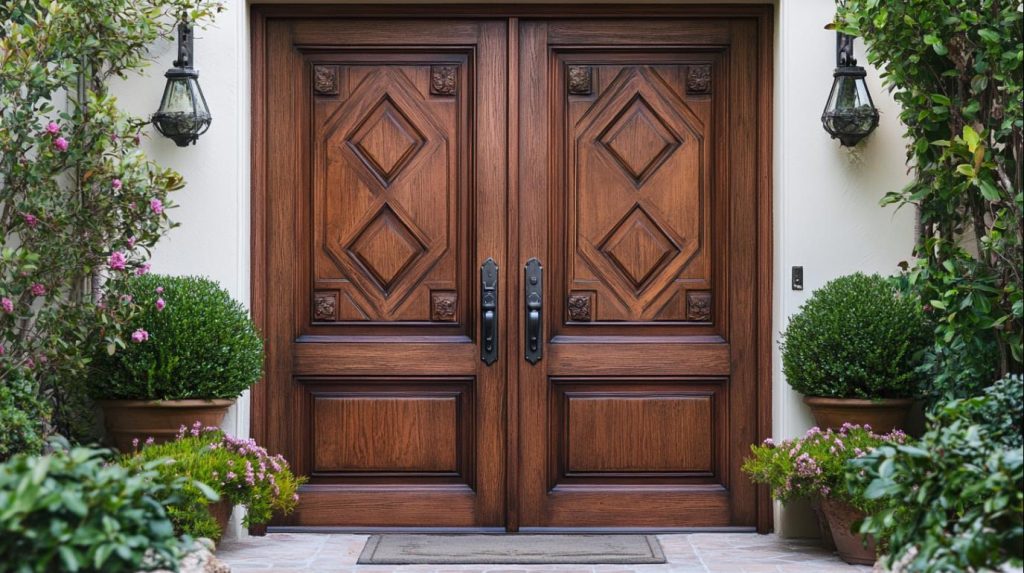
Wood changes the way an entrance feels before you even touch it. With wood double entry doors, the surface doesn’t reflect light sharply—it softens it. That small difference makes the entry feel calmer and more grounded as you approach. Compared to glass or steel, the presence is quieter, but it stabilizes the space in a way that feels natural rather than imposed.
Look more closely, and the design starts to reveal itself through subtle control. The grain direction guides how the entrance is perceived—vertical patterns lift the height, while wider panels or horizontal lines expand the facade visually. In homes that already use natural materials, wood doesn’t compete for attention. Instead, it works like a connector, bringing different elements into one continuous composition.
2. Glass Double Entry Doors

Glass shifts the role of the door from boundary to transition. Among many double entry door ideas, this is the one that most directly connects inside and outside. As you approach, you begin to see through the entrance, and the space starts to unfold before you even step inside. Light travels deeper, reflections shift with movement, and the entry feels less like a stopping point.
The real design decision lies in how much to reveal. Clear glass creates a strong visual connection, making the space feel open and continuous. Frosted or textured finishes, on the other hand, hold the view slightly back, allowing light in while maintaining a sense of privacy. It’s not simply about transparency—it’s about controlling the relationship between exposure and depth.
3. Modern Minimalist Double Doors
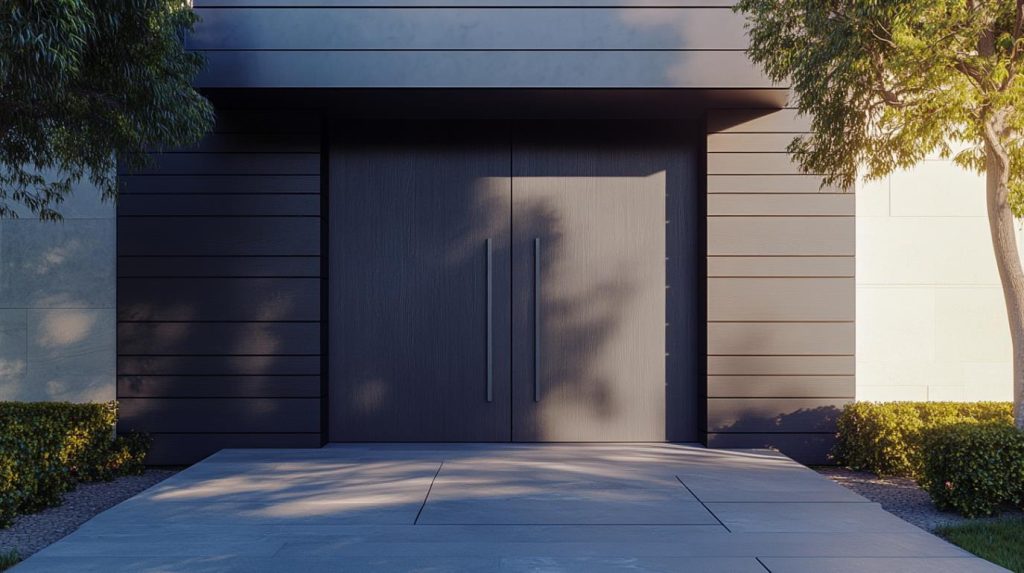
Minimalist double entry doors rely on precision rather than expression. Once decorative elements are removed, proportion becomes the primary language. The alignment of panels, the spacing between elements, and the relationship to the facade all become visible, which means small inaccuracies stand out immediately.
When everything is controlled, the door stops acting as a separate object. It blends into the architecture, reinforcing the overall composition instead of interrupting it. The result feels calm, but not empty. It’s defined by what is necessary, rather than what is added.
4. Arched Double Doors

Introducing a curve changes how the entrance is read. Arched double entry doors soften the rigid geometry of straight lines, allowing the space to feel more relaxed without losing structure. The eye naturally follows the curve upward, which subtly enhances the vertical proportion.
This shift isn’t dramatic, but it’s noticeable. Edges feel less sharp, transitions feel smoother, and the facade carries a different rhythm. Instead of adding complexity, the curve reorganizes the geometry, making the entrance feel more balanced and approachable.
5. Pivoting Double Doors

Pivot doors change the entry experience in a way that standard hinges never do. The movement feels slower, heavier, and more deliberate, which gives the entrance a stronger sense of presence. A regular door swings open and gets the job done. A pivot door, on the other hand, feels like part of the architecture in motion. That difference may sound small, but spatially, it matters a lot. It makes entering feel less casual and more considered.
What also makes pivoting double entry doors interesting is how they change the reading of scale. Because the pivot point sits away from the edge, the door often feels more like a large plane than a panel. This makes the entrance look broader and more sculptural, especially in homes with tall ceilings, deep overhangs, or strong geometric facades. It’s a design that does not depend on ornament. It depends on movement, proportion, and confidence.
6. Double Doors with Decorative Ironwork

Decorative ironwork adds another layer without making the door feel visually heavy. That is what makes it so effective. From a distance, you notice pattern and rhythm. As you get closer, the surface becomes more complex because light begins to pass through it, casting shadows and changing the appearance of the entry over the course of the day. In that sense, ironwork is never completely static. It turns the entrance into something more responsive and atmospheric.
These double front entry doors often work best when the house already carries some visual richness, whether through stucco, stone, arches, or layered trim details. The iron does not need to be elaborate to feel expressive. In fact, the best versions are often the ones that show restraint. A clean pattern or a controlled scroll can add texture and security at the same time. It’s less about decoration in the obvious sense, and more about giving the entrance visual depth and memory.
7. Steel Double Doors
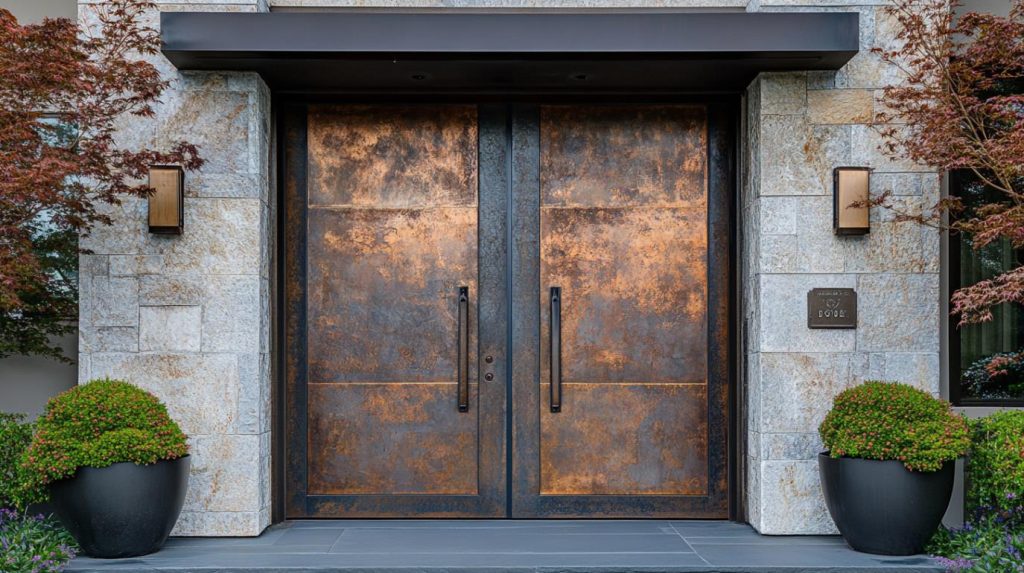
Steel brings discipline to an entrance. The material naturally creates sharper lines, thinner profiles, and a cleaner edge condition, which means the whole composition feels more precise. Where wood tends to soften and glass tends to blur, steel double entry doors define. They establish a stronger boundary and make the facade read more clearly. This is especially useful in homes where the architecture is already geometric and structured.
At the same time, steel does not have to feel cold. That usually depends on what it is paired with. When placed next to warm stone, wood soffits, textured concrete, or controlled lighting, it can feel very refined rather than severe. Its strength is in clarity. It makes the entrance feel crisp, resolved, and intentional, like the design has been tightened rather than decorated. That is why steel works so well in urban homes, minimalist villas, and facades that rely on proportion more than ornament.
8. Frameless Glass Double Doors
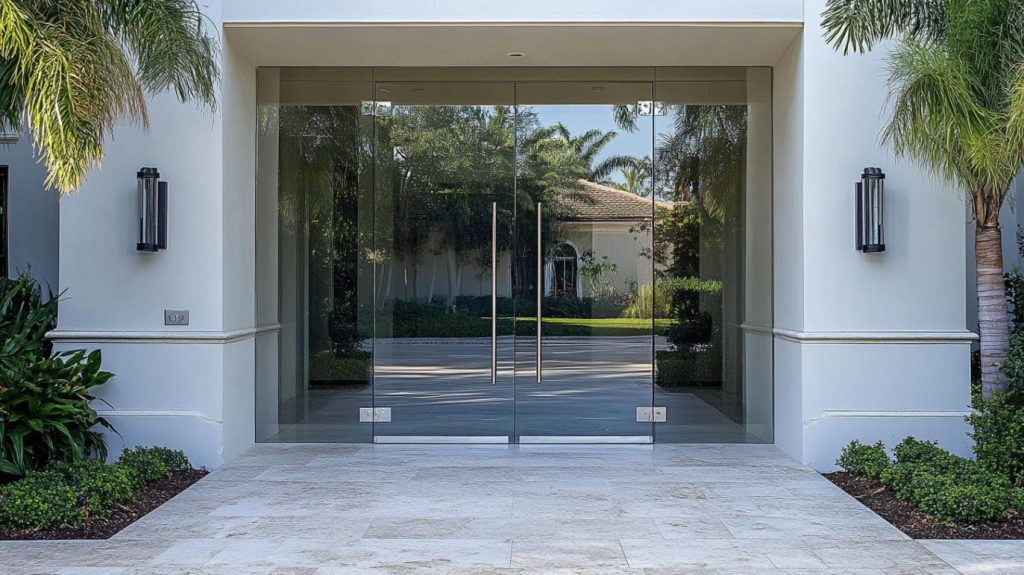
Frameless glass doors work by reducing what normally defines a door. Once the frame is gone, the eye stops focusing on the edge and starts focusing on light, reflection, and what lies beyond. That shift is what gives this design its distinct effect. It does not say, “Look at the door.” It says, “Look through it.” Among the best double entry doors for visually opening a facade, this one feels the least object-like and the most spatial.
But that clarity comes with high demands. Without strong proportions, clean detailing, and a well-resolved surrounding facade, frameless glass can feel exposed rather than elegant. When everything is aligned, though, the result is striking in a very quiet way. The entrance becomes lighter, almost dematerialized, and the transition from exterior to interior feels less like crossing a threshold and more like moving through a layer of space.
9. Double Doors with Side Lights
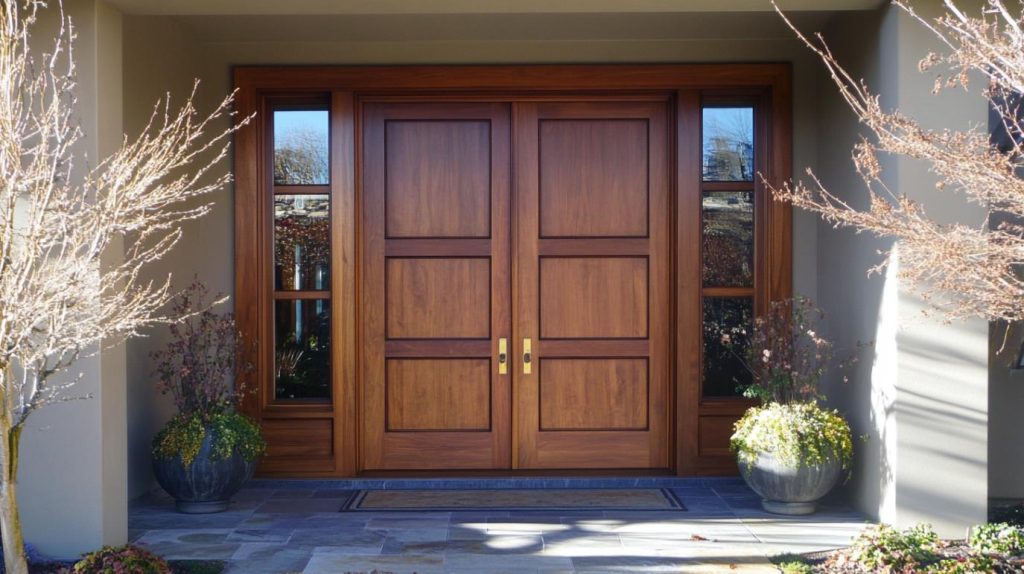
Adding side lights changes the composition without changing the door itself too much, and that is exactly why it works so well. The entrance widens visually, but the center remains clear, so the door still feels anchored. This is one of the most useful double entry door ideas when a house needs more light and a better sense of scale, but the main door design is already doing its job.
What side lights really change is the way the threshold is experienced. Light no longer enters only from the center. It wraps in from both sides, which softens the edge between outside and inside. This makes the entry feel less compressed and more breathable, especially in narrower foyers or deeper front porches. It is a quiet adjustment, but it can completely improve the spatial balance of the entry.
10. Double Doors with Geometric Patterns
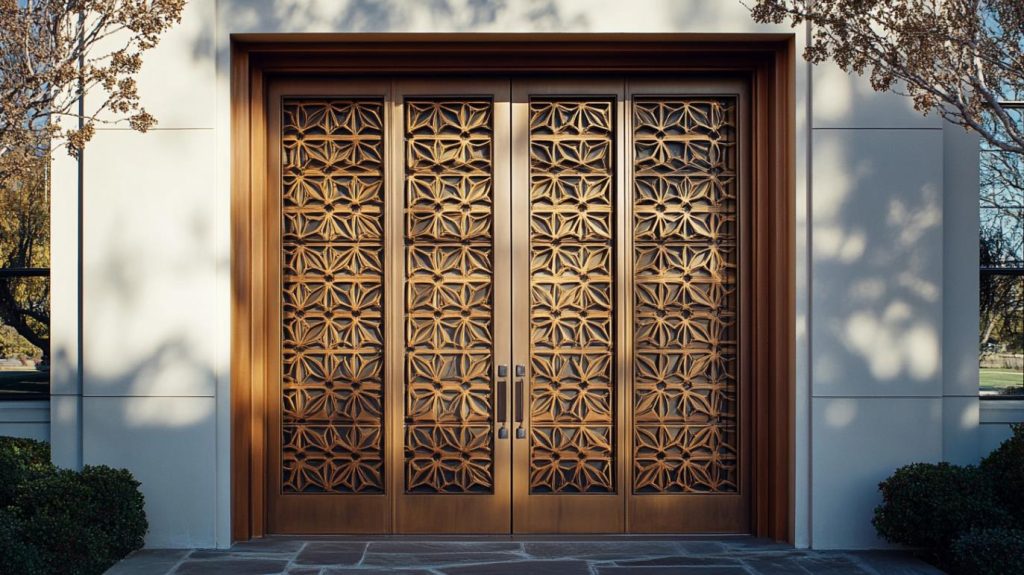
Geometric patterns change the way a flat surface is read. Instead of looking like a single uninterrupted plane, the door gains rhythm, structure, and directional movement. That is what makes these double entry doors feel more architectural than decorative. The pattern is not simply placed on the surface; it organizes the surface, guiding the eye and breaking the scale down into something more controlled.
When done well, this kind of door gives the entrance a distinct identity without needing extra material contrast or excessive detailing. It works especially well on facades that feel too blank or too broad, because it introduces visual structure while keeping the design integrated. The effect is similar to adding order rather than ornament. You are not decorating the door—you are giving it a stronger internal logic.
Conclusion
A great entrance rarely asks for attention, yet it stays in your memory. Sometimes it’s the quiet warmth of wood, sometimes the clarity of steel, and sometimes just the way light moves across glass that makes everything feel resolved. That’s the real strength of double entry doors—they don’t announce themselves, but they define how a home is experienced from the very first step.
What ultimately makes it work is not the style alone, but how everything comes together. Material, proportion, light, and movement all need to feel consistent, as if they belong to the same idea. In well-resolved projects, the entrance is never treated as a separate element. It is considered as part of the whole, which is also the approach followed by PA Home when developing full-home solutions—where the door is not just added, but integrated from the beginning.
Because in the end, the best design doesn’t try to impress. It simply feels inevitable.
FAQs About Double Entry Door
They are not limited to luxury homes. As long as the entrance has enough width and height, double entry doors can work well in many modern houses. The key is proportion. When the size fits the facade, the entrance feels more balanced and more intentional, not oversized.
Not if the design is handled well. The feeling of “too big” usually comes from poor proportion or lack of detail. With the right material, panel layout, or side elements, double doors can actually make the space feel more complete rather than empty.
They are usually more expensive, mainly because of larger size, more materials, and more complex hardware. However, the cost difference also depends on the material and design. In many cases, the visual impact and improved functionality can justify the investment.
Think about how the entrance connects to the whole house. The door should match the facade, the interior style, and even how you use the space daily. A good choice is not the most eye-catching one, but the one that feels natural when you approach the house.