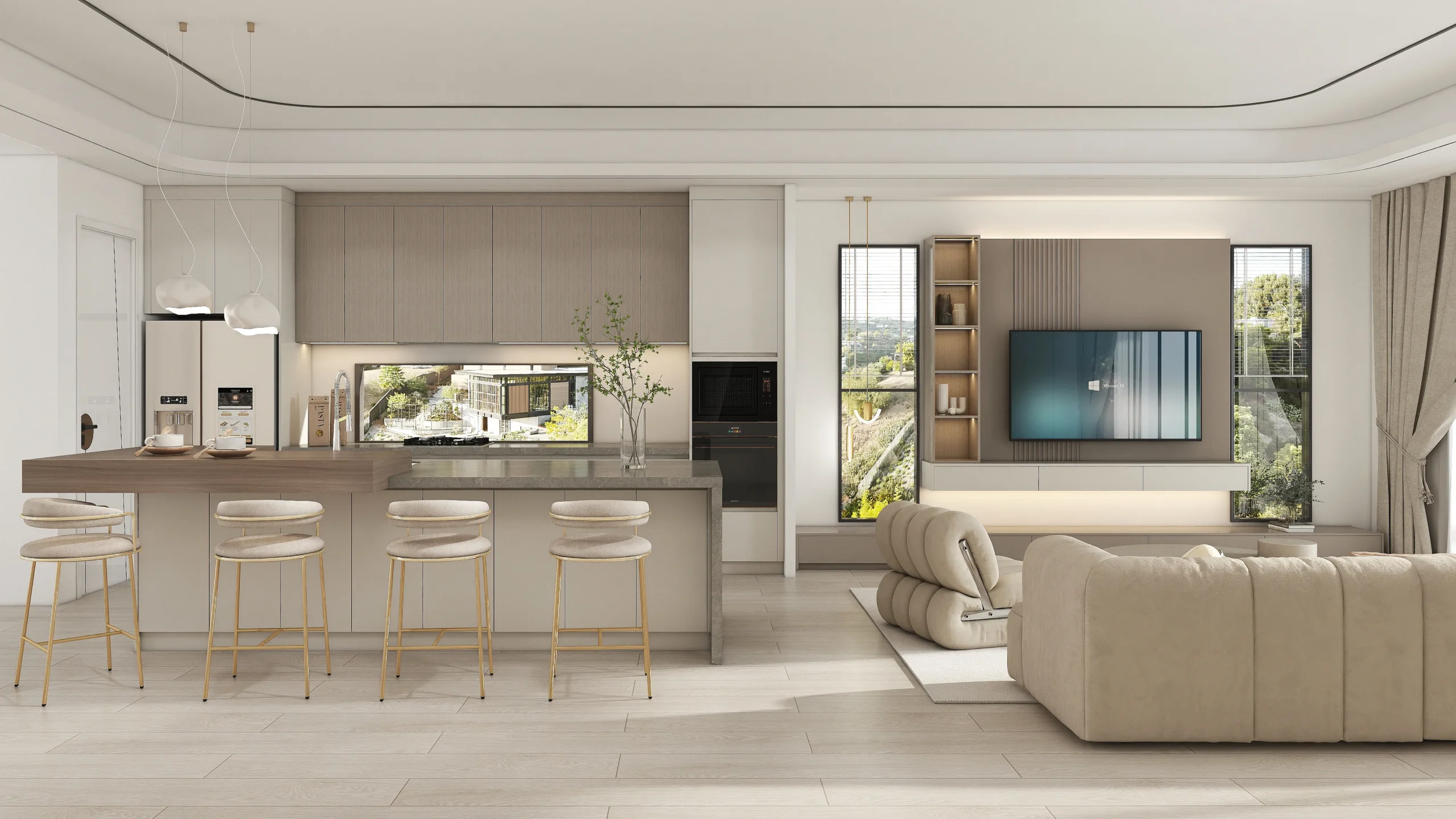
Choosing the right kitchen cabinet material comes down to more than appearance. Strength, moisture resistance, finish, and budget all matter—and the best choice often depends on which part of the cabinet you’re building.
This guide compares five popular options: plywood, MDF, HDF, particleboard, and solid wood, so you can see where each one works best.
Cabinet Material vs. Cabinet Finish
Before comparing kitchen cabinet options, it helps to understand one simple distinction: the material forms the cabinet itself, while the finish creates the visible surface.
Structural/Core Materials
The five materials compared in this guide—plywood, MDF, HDF, particleboard, and solid wood—are commonly used as structural or core materials in kitchen cabinetry.
Surface/Finish Materials
Finishes are applied over a core material to create the final color, texture, and surface appearance.
For example, a cabinet may have a particleboard core with a melamine surface, or an MDF door with a painted finish.
The simplest way to think about it is: the core material affects structural performance, while the finish affects appearance, cleanability, and surface protection.
Kitchen Cabinet Materials at a Glance
Here’s a quick side-by-side comparison before we look at each material in more detail.
| Material | Cost | Strength | Moisture Performance | Paint Finish | Natural Wood Look | Best Fit |
|---|---|---|---|---|---|---|
| Plywood | $$$ | High | Good | Good | Good | Cabinet boxes, shelves |
| MDF | $$ | Medium | Fair | Excellent | Low | Painted doors, panels |
| HDF | $$$ | Medium–High | Fair to Good* | Excellent | Low | Detailed painted fronts |
| Particleboard | $ | Medium | Fair* | Good with surface finish | Low | Budget boxes, shelving |
| Solid Wood | $$$$ | High | Varies with humidity | Very Good | Excellent | Doors, face frames, trim |
*Moisture performance can vary depending on panel grade, sealing, finish, and manufacturing quality.
Ratings are general comparisons only. Performance can vary depending on material grade, thickness, finish, sealing, and manufacturing quality.
There isn’t one material that wins in every category—which is why well-built kitchen cabinets often combine different materials for different components.
5 Best Kitchen Cabinet Materials
The best kitchen cabinet material depends on how the cabinet will be used, the finish you want, and your budget. Below, we compare five common options—plywood, MDF, HDF, particleboard, and solid wood—and look at where each one performs best.
Plywood

Cost: $$$ · Mid to High
Best for: Cabinet boxes, shelves, and drawer boxes
Plywood is made by bonding thin layers of wood veneer together, usually with alternating grain directions. This layered construction gives it good strength and dimensional stability, making it a popular choice for quality kitchen cabinet construction.
Advantages
Limitations
Plywood Grades and Thickness
Not all cabinet plywood is the same. When comparing products, look at panel thickness, veneer quality, core construction, and internal voids rather than relying on the word “plywood” alone.
Kitchen cabinets commonly use plywood from 1/2 inch to 3/4 inch thick. Thicker panels are generally chosen where greater rigidity is needed. A higher ply count can contribute to a more uniform core, but ply count alone does not determine plywood quality.
MDF

Cost: $$ · Low to Mid
Best for: Painted cabinet doors, drawer fronts, and decorative panels
MDF (medium-density fiberboard) is an engineered wood panel made from wood fibers combined with resin and pressed into a dense, uniform board. Unlike plywood or solid wood, it has no visible grain or knots, giving it an exceptionally smooth surface for painted cabinetry.
Advantages
Limitations
Standard MDF vs Moisture-Resistant MDF
Standard MDF works well in dry, properly finished cabinet applications, especially for painted doors and panels. In areas where humidity or occasional moisture is more of a concern, manufacturers may use moisture-resistant MDF (MR-MDF) instead.
MR-MDF is formulated to perform better in humid conditions, but it is important not to confuse moisture resistant with waterproof. Edges, cutouts, and damaged finishes still need proper sealing to reduce the risk of swelling.
HDF

Cost: $$$ · Mid to High
Best for: Painted cabinet doors, routed fronts, and decorative panels
Advantages
Limitations
HDF (high-density fiberboard) belongs to the same general family as MDF, but its denser construction gives it a harder, more compact panel. It retains the smooth, uniform surface that makes fiberboard suitable for precise machining and finishing, which is useful for painted and profiled cabinet components.
 More Concerns
 More Concerns
The main difference is density. HDF is generally denser and harder than standard MDF, while both provide a smooth, uniform surface that works well for painted and routed cabinet components.
In practice, HDF may be preferred when a firmer panel or more precise machining is desired, while MDF remains a widely used and cost-effective choice for painted cabinet doors and decorative panels.
However, the label alone does not determine quality. When comparing HDF or MDF cabinets, also check the panel grade, thickness, moisture resistance, finish quality, and manufacturer specifications.
Particleboard

Cost: $ · Budget
Best for: Budget cabinet boxes, shelving, and panels finished with melamine or laminate
Particleboard is made from wood particles bonded with resin under heat and pressure. It is widely used in kitchen cabinets and shelving, especially when the panel will be covered with a decorative surface such as melamine or laminate. Its performance can vary by grade, density, resin system, and manufacturing quality.
Advantages
Limitations
What Makes a Good Particleboard Cabinet?
The word particleboard alone tells you very little about cabinet quality. ANSI A208.1 classifies particleboard using physical, mechanical, dimensional, and emissions requirements, and different grades can perform differently.
For a kitchen cabinet, it is more useful to check the panel grade, thickness, edge sealing, surface finish, and how shelves are supported. Shelf performance, for example, changes with panel grade, thickness, span, and load rather than material name alone.
If the cabinets are being sold in the U.S., regulated particleboard and finished goods containing it should also comply with EPA TSCA Title VI formaldehyde-emission requirements.
Solid Wood

Cost: $$$$ · Premium
Best for: Cabinet doors, face frames, drawer fronts, and decorative details
Solid wood brings something engineered boards cannot fully reproduce: natural grain, color variation, and texture that are unique to each piece. In kitchen cabinetry, it is especially valued for visible components where the character of real wood is part of the design.
Advantages
Limitations
Wood Species and Natural Movement
Choosing solid wood is only the first step—the wood species and cabinet construction also matter. Different species vary in hardness, grain pattern, color, and how much they change dimensionally as moisture conditions change.
Solid wood naturally gains and loses moisture from the surrounding air, causing it to expand or shrink, especially across the grain. This is a normal property of wood rather than a manufacturing defect. Properly designed cabinet doors account for that movement instead of trying to eliminate it entirely.
That is one reason traditional frame-and-panel doors are common in solid-wood cabinetry: the construction allows the center panel some room to respond to seasonal moisture changes while the surrounding frame provides structure.
How to Select Materials for Custom Kitchen Cabinets?
Choosing materials for custom kitchen cabinets is less about finding one “perfect” material and more about matching each material to the right part of the cabinet. A good material plan should balance durability, appearance, moisture exposure, and budget.
Start With the Cabinet Box
The cabinet box provides the main structure, so strength, stability, and hardware support matter most here. Plywood is a common choice for higher-end construction, while particleboard can be a practical option when budget is a priority.
Match the Door Material to the Finish
The finish you want should influence the door material. MDF and HDF are well suited to smooth painted finishes, while solid wood or wood veneer makes more sense when natural grain is part of the design.
Pay Extra Attention to Moisture-Prone Areas
Sink cabinets and areas near dishwashers deserve more attention to moisture resistance, edge sealing, and finish quality. Even a good panel can fail if exposed edges or joints are poorly protected.
Look Beyond the Material Name
“Plywood,” “MDF,” and “particleboard” are broad categories. Panel grade, thickness, density, core quality, edge treatment, and manufacturing standards can make a significant difference in real-world performance.
Balance Performance With Budget
Custom cabinetry does not need the most expensive material in every component. In many cases, combining materials is the smarter approach—for example, using plywood for structural parts and MDF or solid wood where appearance matters more.
Conclusion
There’s no single kitchen cabinet material that is best for every project. The right choice depends on where the material is used, the finish you want, your budget, and the level of durability you expect.
If you’re looking for the best kitchen cabinet materials and kitchen cabinet designs that fits your space, PA Home can help. We offer professional cabinet solutions and 24-hour online service—feel free to contact us anytime.
FAQs About Kitchen Cabinet Materials
There is no single best material for every part of a kitchen cabinet. Plywood is a strong choice for cabinet boxes, MDF and HDF work well for painted doors, while solid wood is often preferred when natural grain and a premium appearance are priorities.
The cabinet material forms the structural core, such as plywood, MDF, HDF, particleboard, or solid wood. A finish is the visible surface applied over that material, such as paint, laminate, melamine, thermofoil, acrylic, or wood veneer.
Common options include plywood, MDF, HDF, particleboard, and solid wood. Each offers a different balance of cost, durability, and finish quality.
Particleboard is usually the most economical option and is widely used in entry-level and large-volume residential projects.
Hardwoods such as maple, oak, and hickory are among the most durable choices for kitchen cabinets. Hickory is especially hard, while maple and oak offer a strong balance of durability, appearance, and availability.
A luxury kitchen island typically combines premium materials, custom cabinetry, high-end countertops, integrated storage or appliances, quality hardware, and thoughtful lighting. The key is not size alone, but the quality of the materials, craftsmanship, and design details.
Well-built cabinets using quality plywood or solid wood, durable finishes, strong hardware, and proper installation tend to last the longest. Material quality, moisture protection, and construction methods matter just as much as the cabinet material itself.
Well-built cabinets using quality plywood or solid wood, durable finishes, strong hardware, and proper installation tend to last the longest. Material quality, moisture protection, and construction methods matter just as much as the cabinet material itself.
In 2026, natural wood cabinetry, warmer tones, cleaner flat-panel designs, and smarter built-in storage are among the strongest trends. Wood finishes are gaining ground over all-white cabinetry, while customized storage and integrated features are also becoming more popular.