When booking a hotel, you’ll often see the term “Standard Room,” but it does not refer to one fixed room size. Hotel room dimensions can vary widely depending on the country, city, star rating, building age, brand standards, and even the specific property.
In general, hotel rooms in North America tend to be more spacious, European city hotels are often more compact, and rooms in Asia can vary significantly between dense urban markets and resort destinations. That’s why understanding standard hotel room size is not just about finding one average number. It’s more useful to look at typical size ranges by region, room type, and hotel category.
What Is a Standard Hotel Room Size?
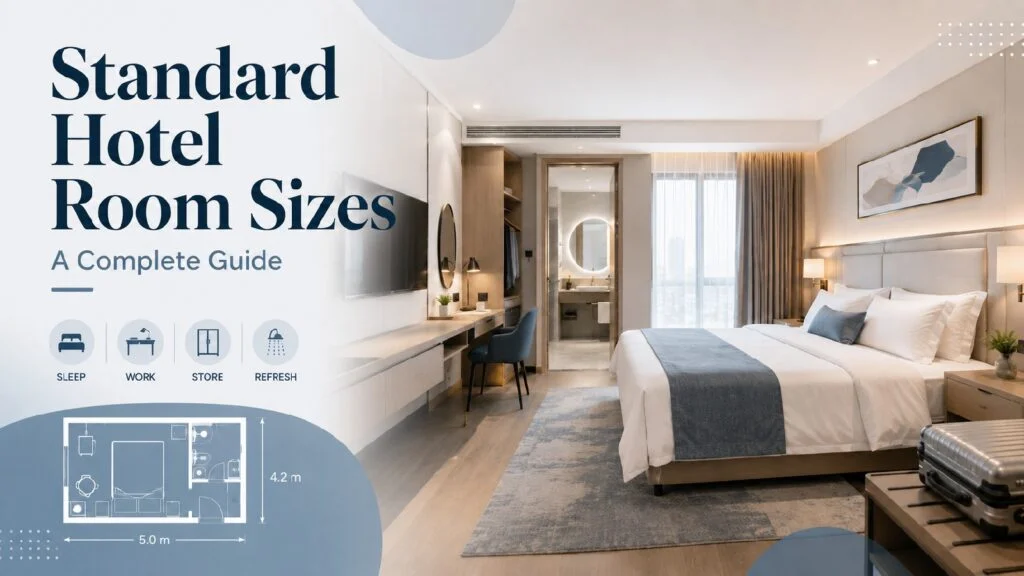
A standard hotel room is usually the hotel’s basic or entry-level room type, but it does not follow one fixed global size rule. In most cases, a standard room is designed to include the essentials: a bed, bedside tables, a TV, a small desk or seating area, storage space, and a private bathroom.
As a general reference, a typical standard hotel room is often around 200 to 350 square feet, or approximately 19 to 33 square meters. Rooms below this range may feel more compact, while rooms above it usually offer more comfort, especially for two guests, longer stays, or travelers with large luggage.
The actual size can vary depending on the region, hotel category, building age, brand standards, and how the hotel calculates room area. Some hotels include the bathroom and entryway in the listed size, while others may focus more on the main sleeping area. That’s why it is always better to check the actual square footage, layout, bed type, and room photos instead of relying only on the name “standard room.”

Key Factors Influencing Hotel Room Dimensions
Hotel room dimensions are shaped by more than just the room name. Even when two hotels both offer a “standard room,” the actual space can feel very different. The following factors usually have the biggest impact on room size.
Hotel Star Rating
Star rating is one of the easiest clues to estimate hotel room size. Higher-rated hotels usually offer more space, better layouts, larger bathrooms, and more comfortable furniture, while lower-rated hotels tend to focus on basic function and efficiency.
1-Star Hotel
Rooms are usually very basic and compact, often around 100–200 sq ft / 9–19㎡. The space typically focuses on the essentials: a bed, simple storage, and a bathroom.
2-Star Hotel
Rooms are still simple but slightly more functional, often around 150–250 sq ft / 14–23㎡. You may find a small desk, better storage, or a more practical bathroom layout.
3-Star Hotel
This is a common range for standard hotel rooms, usually around 200–300 sq ft / 19–28㎡. Rooms are generally comfortable enough for short stays, business trips, and everyday travel.
4-Star Hotel
Rooms are usually more spacious and polished, often around 300–400 sq ft / 28–37㎡. Guests can expect better furniture, a larger bathroom, improved lighting, and a more comfortable work or seating area.
5-Star Hotel
Luxury rooms often start around 400 sq ft / 37㎡ and may be much larger. These rooms usually offer premium finishes, generous bathrooms, lounge areas, and a stronger sense of privacy and comfort.
Location and Market
Location has a major influence on room size. Hotels in dense city centers often have smaller rooms because land and construction costs are higher. In places such as New York, London, Paris, Tokyo, or Hong Kong, every square foot matters. By contrast, suburban hotels, business parks, and resort properties usually have more space to create larger rooms.
Building Age and Layout
Older hotels, especially those in historic buildings, often have smaller or irregularly shaped rooms. Newer hotels are more likely to follow modern planning standards, with clearer circulation, better storage, improved bathroom layouts, and more consistent room dimensions.
Guest Type and Length of Stay
A hotel designed for short business trips may prioritize a compact but functional layout with a desk, easy circulation, and efficient storage. A resort, family hotel, or extended-stay property usually needs more space for seating, wardrobes, luggage, kitchenettes, or separate living areas.
Room Features and Measurement Method
The listed room size may include the bathroom, entryway, wardrobe area, or balcony, depending on how the hotel calculates it. This means two rooms with the same square footage can still feel different. Layout, window placement, ceiling height, furniture size, and bathroom design all affect how spacious the room feels in real life.
Average Hotel Room Size by Region
Hotel room sizes vary widely by region. A standard room in North America may feel spacious, while a room with the same label in a dense European or Asian city may be much more compact. The table below gives a practical overview of common standard room sizes in different regions.

| Region | Common Standard Room Size | Approx. in Square Meters | What to Expect |
|---|---|---|---|
| North America | Around 300–325 sq ft | Around 28–30㎡ | Usually more spacious, often with a king bed or two queen beds, a work desk, luggage space, and a private bathroom. |
| Europe | Around 150–215 sq ft | Around 14–20㎡ | Generally more compact, especially in historic city centers. Smart layouts, built-in storage, and smaller bathrooms are common. |
| Asia | Around 100–300 sq ft | Around 9–28㎡ | Highly variable. Rooms in cities like Tokyo, Hong Kong, Singapore, and Seoul may be smaller, while newer business hotels and resort areas often offer more space. |
| Australia | Around 200–250 sq ft | Around 19–23㎡ | Typically more moderate in size, with standard rooms often designed for short stays, business travel, or leisure trips. |
| Middle East | Around 300–400 sq ft | Around 28–37㎡ | Many hotels, especially newer and upscale properties, tend to offer larger rooms with more generous layouts. |
These numbers should be used as general references rather than fixed rules. Room size can still vary by city, hotel brand, building age, and property type, so it is always worth checking the actual listed area before booking.
Standard Hotel Room Size by Room Type
Room type is often a better clue than the word “standard” alone. While the exact name may vary from one hotel to another, most rooms fall into a few broad categories based on size, layout, and level of comfort.
Economy or Midscale Hotel Room Size
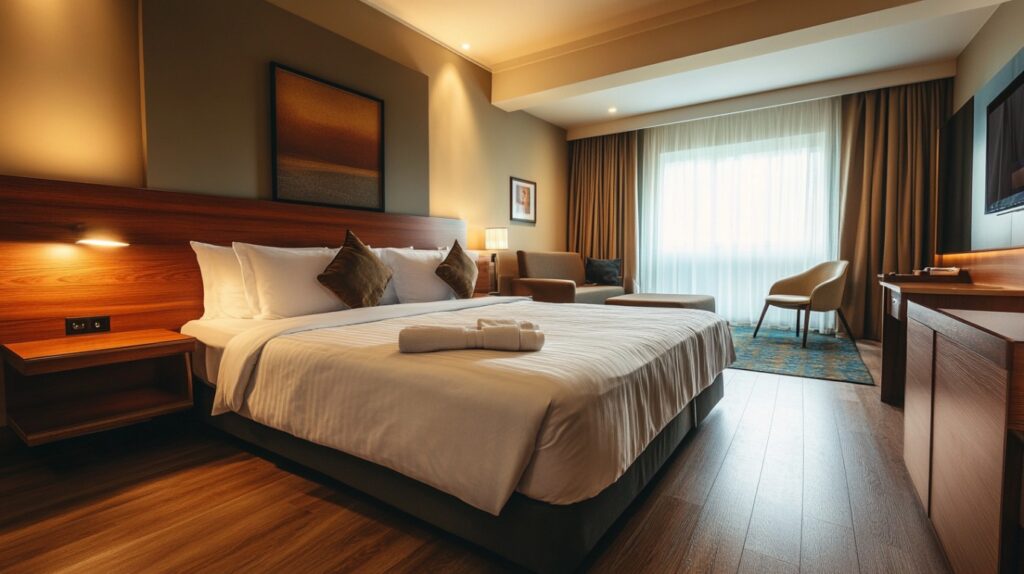
Common size: 190–300 sq ft / 18–28㎡
Economy and midscale hotel rooms are usually designed with efficiency in mind. The layout tends to be compact, but every part of the room has a clear purpose.
Instead of large wardrobes or extra lounge furniture, they may use open hanging space, wall hooks, a smaller desk, or a shower-only bathroom to save floor area.
Deluxe or Superior Hotel Room Size
Common size: 300–390 sq ft / 28–36㎡
A superior or deluxe hotel room usually offers a step up from the standard category. The upgrade may come from more space, but it can also come from better views, improved furniture, a larger bathroom, or a more polished interior design.
Compared with a standard room, the layout often feels more open, with enough room for a lounge chair, vanity area, or a more comfortable work corner.
Premium or Luxury Hotel Room Size
Common size: 400–650 sq ft / 37–60㎡
Premium and luxury hotel rooms are designed to feel more generous and refined. The extra space is not just about size; it is usually used to create clearer zones for sleeping, relaxing, working, and getting ready.
Guests can usually expect a larger bathroom, better materials, more seating, and a layout that feels less crowded.
Suite Size
Common size: 390–1,000+ sq ft / 36–93㎡+
A suite is different from a larger guest room because it usually offers some level of separation between spaces. A junior suite may have a sitting area within the bedroom, while a one-bedroom suite often includes a separate living room.
Larger suites may include dining space, multiple bedrooms, a kitchenette, a private terrace, or entertainment areas.
Standard Hotel Room Layout and Dimensions

A standard hotel room is usually planned around a simple idea: keep the space easy to move through, comfortable to sleep in, and practical for short stays. While room shapes vary, many standard rooms use a rectangular layout because it is efficient for placing the bed, bathroom, desk, storage, and circulation path.
A common standard room may be around 12–14 feet wide and 20–25 feet deep, depending on the total area and whether the bathroom is included in the measurement. For example, a room close to 300 square feet may be arranged as roughly 12 × 25 feet, 13 × 23 feet, or 15 × 20 feet. The exact proportions can change, but the goal is usually the same: to create a clear path from the entrance to the bed, bathroom, window, and work or seating area.
Most standard hotel rooms include a few key zones:
- Entry area: Usually includes the door, luggage space, closet, or open hanging area.
- Bathroom: Often placed near the entrance to simplify plumbing and keep the sleeping area more open.
- Sleeping area: The main part of the room, usually centered around a queen, king, or two-bed setup.
- Work or seating area: A small desk, chair, lounge chair, or built-in bench, depending on the room size.
- Storage and circulation: Enough space to walk around the bed, open luggage, and access the bathroom comfortably.
In a well-designed room, the layout often matters as much as the square footage. A smaller room can feel comfortable if the furniture is scaled properly, the walkway is clear, and storage is built into unused corners. On the other hand, a larger room may still feel awkward if the bed, desk, bathroom door, and luggage area compete for the same space.
For travelers, the best way to judge layout is to look beyond the listed size. Check whether the room has space around the bed, a usable desk or seating area, enough luggage space, and a bathroom that does not crowd the entrance. These details often tell you more about comfort than square footage alone.
ADA / Accessible Hotel Room Size Requirements

Accessible hotel rooms are not defined by one fixed square footage. Instead, ADA requirements focus on whether guests can move through the room, approach the bed, use the bathroom, and access key features safely and comfortably.
In general, an accessible hotel room should provide enough clear floor space for wheelchair movement, including a turning area, an accessible route through the room, and usable space beside the bed. The bathroom must also be designed so guests can access the toilet, sink, bathtub, or shower without barriers.
Key accessibility features usually include:
- Clear turning space inside the guest room
- Clear floor space beside the bed for wheelchair access
- Accessible bathroom layout with compliant toilet, lavatory, bathtub, or shower
- Reachable controls and fixtures, such as switches, outlets, thermostats, and closet features
- Accessible exterior spaces, such as balconies or terraces, if they are part of the room
Because accessible design depends on clearance, layout, door swings, bathroom fixtures, and furniture placement, accessible rooms are often larger than standard rooms. However, the exact size can vary by hotel and local building code. For travelers, the most important thing is to check whether the room is labeled as accessible, whether it has a roll-in shower or accessible bathtub if needed, and whether the hotel provides clear room details before booking.
How to Make a Small Hotel Room Feel Bigger?
A small hotel room does not have to feel uncomfortable. Good design can make a compact space feel more open, organized, and easy to use. The key is to reduce visual clutter, keep circulation clear, and make furniture serve more than one purpose.
Use Built-In and Wall-Mounted Furniture
Built-in desks, floating shelves, wall-mounted TVs, and compact bedside tables help free up floor space. When furniture sits close to the wall and does not block the walking path, the hotel room feels cleaner and easier to move through.

Keep Storage Simple and Visible
Open hanging rails, luggage benches, hooks, and under-bed storage can work better than bulky wardrobes in small rooms. They make it easier for guests to unpack without filling the floor with bags and clothing.
Choose Light Colors and Better Lighting
Light-colored walls, soft neutral tones, and layered lighting can make a room feel brighter and less closed in. A mix of ceiling lights, bedside lamps, and task lighting also helps separate the room into sleeping, working, and relaxing areas.
Use Mirrors and Glass Carefully
Mirrors can reflect light and create a stronger sense of depth. Glass shower doors, instead of heavy curtains or solid partitions, can also make a compact bathroom feel more open.

Make the Layout Easy to Move Through
The most important part of a small room is the walking path. Guests should be able to enter the room, reach the bed, open luggage, and access the bathroom without moving furniture around. Even a small room can feel comfortable if the layout is simple and uncluttered.
Reduce Unnecessary Furniture
A compact room should not try to include everything. One well-placed chair, a slim desk, or a built-in bench is often better than oversized furniture that makes the room feel crowded. In small hotel rooms, every piece should have a clear purpose.
Conclusion
Hotel room size matters, but smart space planning matters even more. A well-designed room should make the available area feel comfortable, practical, and easy to use, whether it is a compact city room or a spacious luxury suite.
For hotel owners, developers, and designers, the right furniture can make a major difference. Built-in storage, space-saving desks, comfortable beds, vanities, wardrobes, and customized layouts can help every square foot work harder without making the room feel crowded.
Looking for hotel furniture for your project? Contact PA Home to explore more hotel room furniture designs. As a top hotel furniture manufacturer, PA Home customized furniture packages for different hotel room layouts.
A standard hotel bathroom is usually around 35 to 60 sq ft / 3 to 6㎡. Compact city hotels may be smaller, while upscale hotels often have larger bathrooms with more counter space, a bathtub, or a separate shower area.
An average hotel room in Europe is usually around 150–215 sq ft / 14–20㎡. Rooms in historic city centers such as Paris, London, Rome, or Amsterdam are often more compact, while newer or upscale hotels may offer more space.
A standard hotel room floor plan is often around 12–14 ft wide and 20–25 ft deep, depending on the total room size and layout. Common layouts place the bathroom near the entrance, the bed in the main sleeping area, and a small desk, seating area, or storage space along the wall.
A standard hotel room usually has a queen bed, king bed, or two double/queen beds. Common bed sizes are Queen: 60 × 80 in, King: 76 × 80 in, and Double/Full: 54 × 75 in, though sizes may vary slightly by country and hotel brand.
A decent hotel room size is usually around 250–350 sq ft / 23–33㎡. This range typically feels comfortable for one or two guests, with enough space for a bed, bathroom, luggage, and a small desk or seating area.